
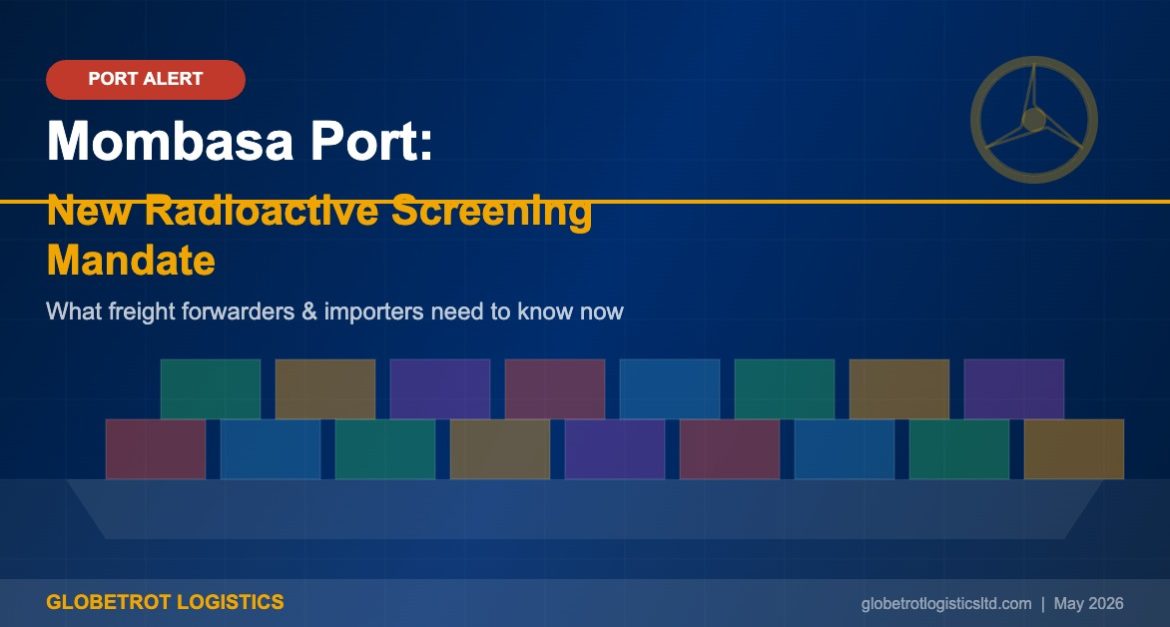
Effective May 1, 2026, every container, vehicle, and consignment passing through the Port of Mombasa is now subject to mandatory radioactive material screening under a new directive from the Kenya Nuclear Regulatory Authority (KNRA). While the regulation is a welcome step toward national security and compliance with international safety standards, it has sent shockwaves through East Africa’s freight community — raising serious concerns about clearance speeds, dwell time costs, and the port’s hard-won efficiency gains.
What the New KNRA Screening Mandate Entails
The Kenya Nuclear Regulatory Authority’s mandate requires all cargo — both imports and exports — to undergo radiation scanning before release or loading. The directive applies to all terminals at the Port of Mombasa and is part of a broader framework to prevent the illicit movement of radioactive and nuclear materials through Kenyan ports.
On paper, the regulation is sound. Kenya, as a signatory to international nuclear safety protocols, has a legal obligation to screen cargo for radiological threats. The directive aligns Mombasa with major global ports including Singapore, Rotterdam, and Jebel Ali, which have long operated similar scanning systems. What concerns freight stakeholders, however, is not the regulation itself — but the timing, infrastructure readiness, and the simultaneous return of multiple government agencies to the port.
Why the Freight Community Is Worried
Mombasa has spent several years reducing bureaucratic bottlenecks at the port. The Kenya Ports Authority (KPA) made significant progress in streamlining cargo clearance through the Kenya TradeNet system, integrating agency functions, and digitizing documentation workflows. Average dwell times for containers had been brought down substantially — a major selling point for Mombasa as a competitive transhipment and gateway hub serving Uganda, Rwanda, the DRC, South Sudan, and beyond.
Now, several freight forwarders and clearing agents are warning that the new screening regime — combined with the return of multiple physical state agency inspections — risks adding days to clearance timelines. Longer dwell times translate directly into higher demurrage charges, increased warehousing costs, and disrupted supply chains for manufacturers, retailers, and importers across the region.
The FEAFFA (Federation of East African Freight Forwarders Associations) has called for transparent timelines from KNRA and KPA on how the screening infrastructure will be operationalized, and has urged that adequate scanning equipment be deployed at all berths to prevent bottlenecks at single checkpoints.
The Bigger Picture: Mombasa’s Impressive Growth Trajectory
It would be a mistake to frame this development only through the lens of disruption. The Port of Mombasa continues to perform at record levels. In 2025, the port handled 45.45 million tonnes of cargo — a 10.9% increase over the previous year. Transit cargo surged by 19.5% to reach 15.88 million tonnes, reflecting the Northern Corridor’s growing role as the economic artery of East and Central Africa.
Further strengthening Mombasa’s gateway status, a new bi-weekly East Africa Service now connects South Asian ports — including Nhava Sheva, Mundra, and Karachi — directly with Mombasa and Dar es Salaam. A leading Korean shipping line has also completed its inaugural voyage to Mombasa, signaling growing international confidence in the port’s capabilities.
These are the gains that are at stake if the KNRA mandate is not implemented with adequate infrastructure and operational planning. A reactive rollout could undo years of efficiency improvements.
What This Means for Your Cargo Clearance
For importers, exporters, and freight forwarders using Mombasa as a gateway, here is what you need to know right now:
- Build extra dwell time into your planning: Until screening operations are fully scaled and running smoothly, add a minimum of 2–4 additional business days to your expected cargo release timelines.
- Ensure complete and accurate documentation: Any discrepancies in cargo manifests, classification codes, or consignment details could trigger additional scrutiny under the new screening protocol. Double-check all documentation before vessel arrival.
- Stay updated on KNRA exemptions: Certain cargo categories — such as medical isotopes and industrial radiation equipment — may require pre-clearance permits from KNRA. Work with your freight forwarder to identify if your consignment falls into any regulated category.
- Budget for potential demurrage: With containers potentially spending longer in the port during the transition period, ensure your shipping contracts include adequate demurrage provisions or consider arranging temporary off-dock storage.
- Communicate with your supply chain partners: Alert your customers, distributors, and suppliers to the potential for delays so that downstream plans can be adjusted accordingly.
Our Commitment to Keeping Your Cargo Moving
At Globetrot Logistics, we are working closely with port authorities, customs agents, and our operational teams at Mombasa to monitor the rollout of the KNRA screening mandate in real time. We are committed to keeping our clients fully informed and to identifying the fastest, most cost-effective clearance pathways available as the situation evolves.
If you have shipments due to arrive at Mombasa in the coming weeks, we strongly encourage you to reach out to our team for a proactive clearance review. Preparation now will save significant cost and stress later.
Contact Globetrot Logistics today to discuss how we can help you navigate the new Mombasa port compliance landscape.


